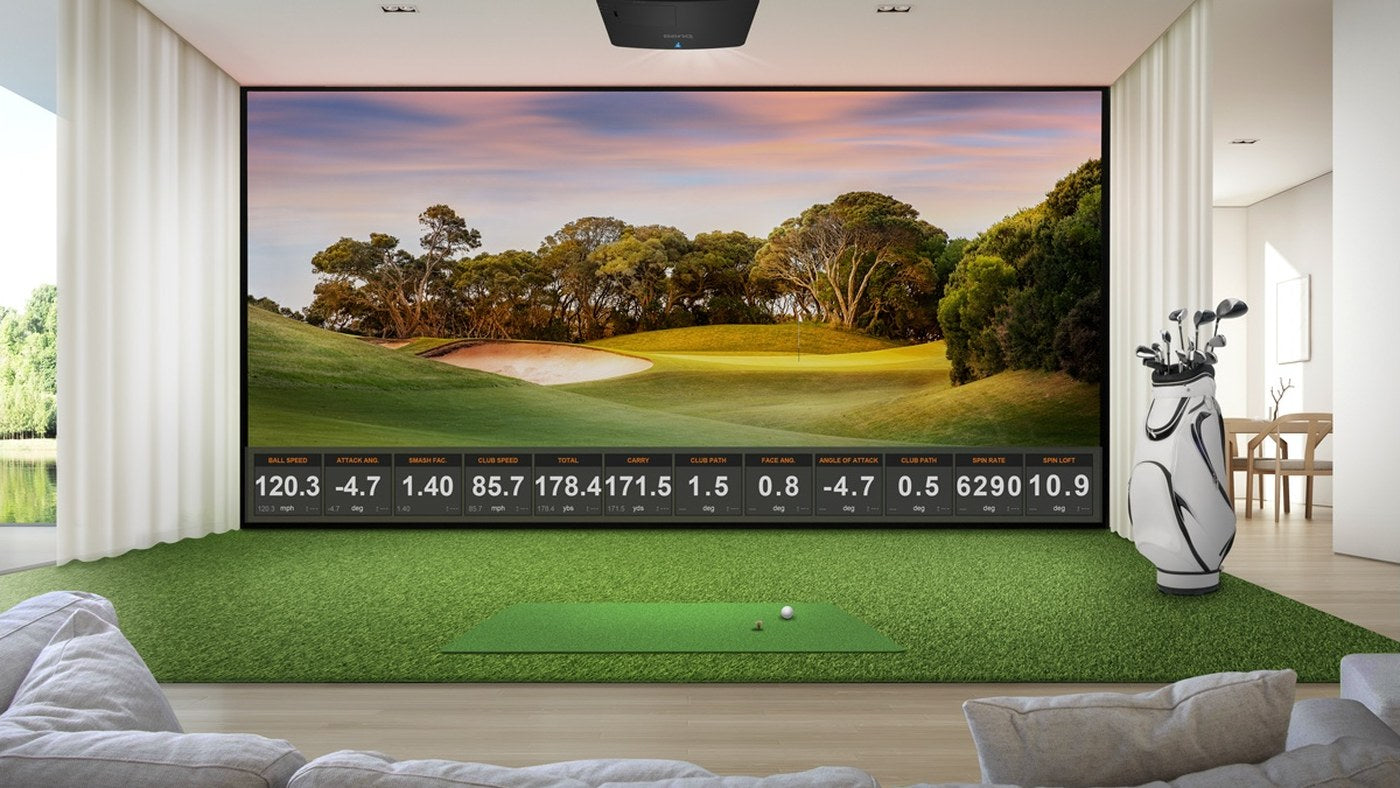

In the Indoor Golf Kit catalogue, a Carl’s Place enclosure package adds pipe framing and listed accessories to the corresponding enclosure kit. The package still needs the other parts of a working simulator, including a hitting surface and electronics. Compare the itemized contents before deciding which option costs less for your room.
There are two separate decisions: DIY or Pro structure, then kit or package scope. Our DIY vs Pro comparison covers the first. This guide covers what comes with each of the four listings and how to avoid missing or duplicating parts.
Compare the four listings
| Component | DIY kit | DIY package | Pro kit | Pro package |
|---|---|---|---|---|
| Selected screen, surround and frame fittings | Included | Included | Included | Included |
| Main pipe framing | Separate | Included | Separate | Included |
| Back cover fabric | Separate | Included | Separate | Included |
| Back cover pipe kit | Separate | Included | Separate | Included |
| Safety baffle | Separate | Included | Separate | Included |
| Foam insert kit | Optional accessory in reviewed listing | Included | Included in reviewed model | Included |
| Net wall extensions | Separate | Included as listed | Not listed as included | Not listed as included |
| Launch monitor, projector, computer and software | Separate | Separate | Separate | Separate |
| Hitting mat and putting turf | Separate | Separate | Separate | Separate |
Use the current selected configuration to confirm contents. The DIY package lists the net wall extensions as its 8-foot-depth accessory version; that description does not mean every enclosure in the package is 8 feet deep.
Open the four relevant pages while comparing: DIY kit, DIY package, Pro kit and Pro package. Package contents are the retailer’s listed bundle, so an identically named product elsewhere may have a different scope.
Main framing and back cover framing are different lines
The main pipe kit builds the enclosure structure. The back cover pipe kit supports the matching rear cover arrangement. Seeing “pipe framing included” in a quote should prompt you to identify which of these it describes.
The reviewed DIY system uses 1-inch EMT; the Pro system uses 2-inch EMT. These are trade sizes. Match the actual enclosure family, dimensions and cut sheet when sourcing pipe or choosing a pre-cut kit. A kit from the other family is not a substitute merely because its nominal width is similar.
For a base-kit purchase, make the pipe plan explicit: manufacturer-supplied kit, separately ordered matching accessory, or locally sourced pipe cut to the supplied dimensions. Include transportation and cutting arrangements in that comparison.
Assign each accessory a job
| Accessory | Question to resolve in your room |
|---|---|
| Back cover | Is rear light control or coverage part of the planned installation? |
| Back cover pipe kit | Which matching structure supports that selected cover? |
| Net wall extensions | Where will the extensions sit relative to the hitting position and room access? |
| Safety baffle | Which compatible baffle and mounting position does this enclosure require? |
| Foam inserts | Does the selected kit already include the matching inserts? |
| Equipment mount or crossbar | Is it separately specified and compatible with the exact structure and device? |
A package can simplify ordering when its included accessories match the plan. Its value is less clear if several included components duplicate equipment already owned or do not fit the intended layout. Decide that from a parts list rather than from the number of accessories pictured.
Compare the complete cost with one worksheet
Use the same enclosure size and screen material on both sides of the comparison. Then calculate:
Kit route = base kit + missing matching accessories + pipe sourcing and cutting + delivery or transport costs.
Package route = selected package + anything still missing + applicable delivery or installation costs.
Keep labor in a separate line, even if you intend to do it yourself. A pre-cut frame may remove a sourcing task, but assembly and room preparation still remain. Use current cart or quote amounts rather than a starting price shown for the smallest size.
Example: a buyer who already owns a rear cover
First verify that the existing cover belongs to the same enclosure family, size and generation. If it does, compare the kit plus the remaining needed parts against the package. If it does not, treat it as an unresolved item rather than subtracting its cost automatically.
Example: a buyer starting with an empty room
List every package component as supplied, then add the hitting surface, projector, mounting equipment, launch monitor, computer and software separately. That keeps the enclosure decision visible inside the wider simulator budget.
Check size and generation across every line
Copy the selected enclosure’s exact size description into your order notes. Match each cover, pipe kit, baffle and insert to it. The outside frame size, viewing area and finished screen size have different uses; do not use one as a replacement-part identifier for another.
If a component description refers to a newer Pro design while another document shows an older arrangement, request the assembly documents for the supplied configuration. The matching parts and instructions should describe the same system before the order is finalized.
What should the final order summary say?
It should identify the enclosure family, exact size, screen material, main pipe supply, rear cover and rear pipe supply, protective accessories, and any separately selected mounting equipment. Mark existing items as “verified compatible,” not simply “already owned.”
With that summary complete, the DIY enclosure package and Pro enclosure package become straightforward alternatives to a kit plus individually selected accessories. Choose the route that supplies the needed parts for the room you are actually building.